
Abstract
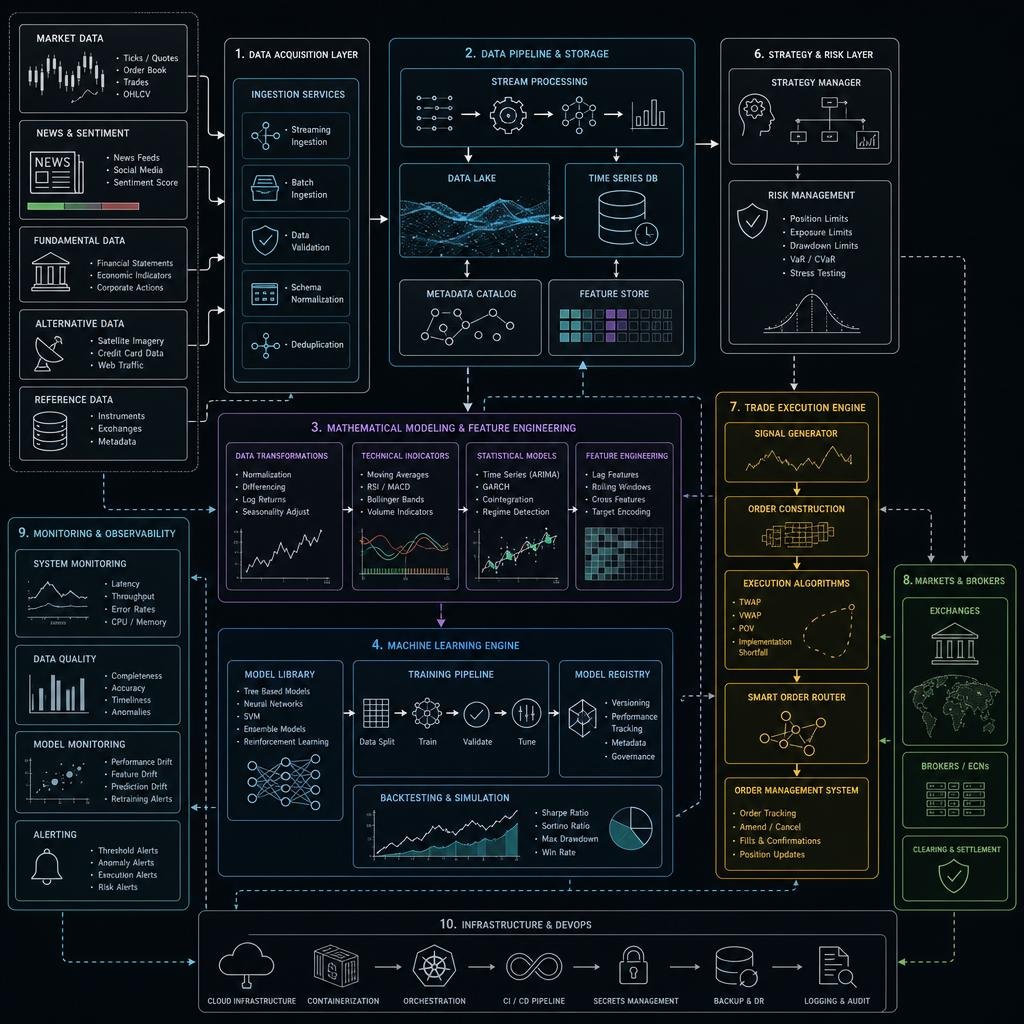
This paper examines the efficacy of advanced mathematical models in the realm of algorithmic trading (algo-trading). The focus is to bridge mathematical theory with practical applications in financial markets. In order to delve deeper into the intricacies of algorithmic trading, we introduce a series of mathematical frameworks that guide decision-making processes in high-frequency trading (HFT). Additionally, this research scrutinizes the influence of these models through technical analysis and back-testing strategies, providing a robust understanding of their real-world applicability.
Mathematical Framework
At the core of algo-trading lies the mathematical underpinning which encompasses stochastic calculus, time-series analysis, and optimization. A foundational aspect is the use of stochastic differential equations (SDEs), which describe the unpredictable behavior of asset prices. Consider the Black-Scholes model, a quintessential SDE given by:
$$ dS(t) = \mu S(t) dt + \sigma S(t) dW(t) $$
Here, S(t) represents the asset price at time t, \( \mu \) denotes the drift, \( \sigma \) the volatility, and \( dW(t) \) is a Wiener process or Brownian motion.
Furthermore, portfolio optimization is a critical component of algo-trading. We employ the mean-variance framework to maximize the expected return for a given level of risk, represented by:
$$ \max \limits_{w} E(R_p) = w^T \Sigma w $$
where w is the weight vector of the assets in the portfolio, \( E(R_p) \) is the expected portfolio return, and \( \Sigma \) is the covariance matrix of returns.
Technical Analysis
Technical analysis plays an instrumental role in algorithmic trading. It involves the use of historical market data to forecast future price movements. Key indicators such as moving averages, relative strength index (RSI), and Bollinger Bands inform strategic trades. High-frequency trading strategies capitalize on these indicators, executing trades within milliseconds to leverage minute price discrepancies.
An advanced facet of technical analysis is the implementation of machine learning algorithms to enhance predictive models. Machine learning tools such as support vector machines and neural networks can sift through vast datasets to identify latent patterns that are imperceptible to traditional models, thereby optimizing trade execution.
Conclusion
In conclusion, mathematical models and technical analysis are indispensable for effective algo-trading strategies. The integration of complex mathematical frameworks allows for an enhanced understanding of market dynamics, while technical analysis provides the tools for precise market predictions and trade executions. As algorithmic trading continues to evolve, future research must address the challenges associated with high-frequency data analytics and the ethical implications of automated trading systems.