
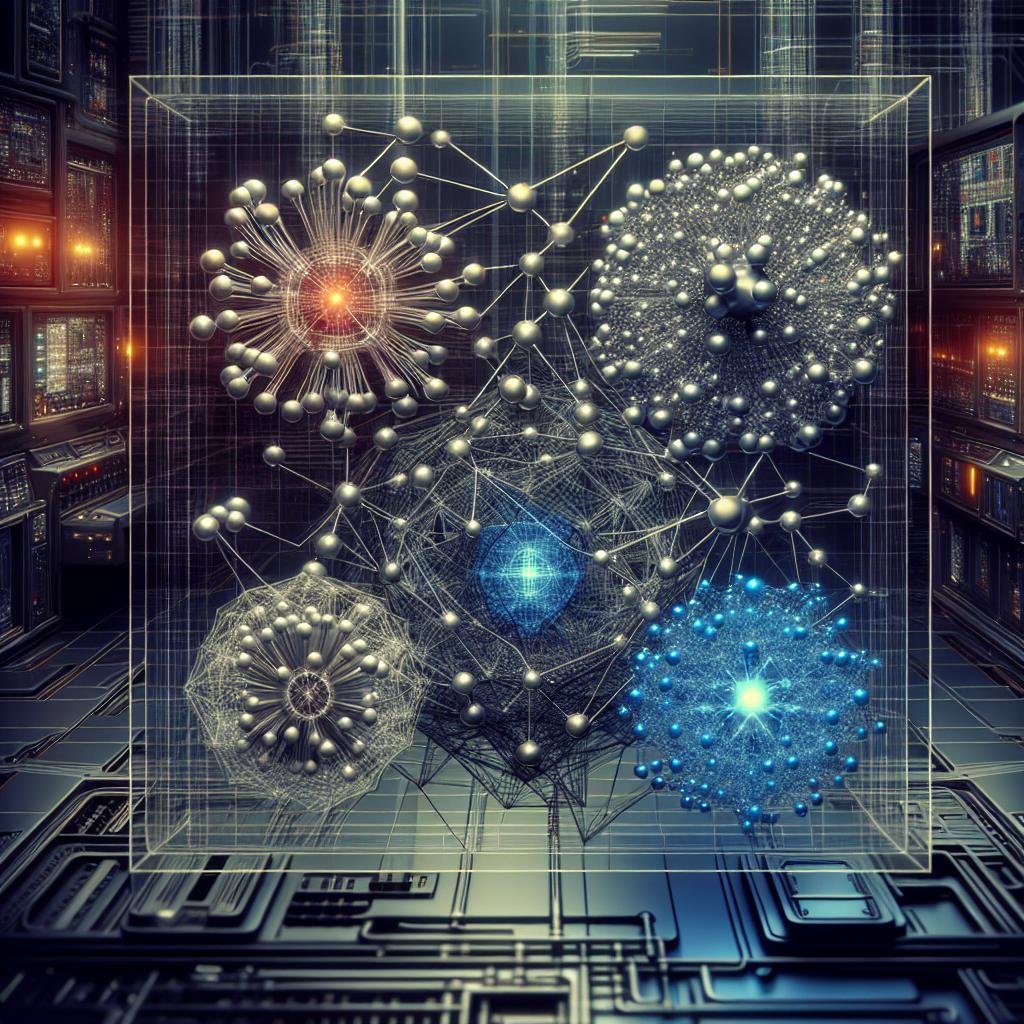
Introduction: The relentless pursuit of advanced computational capabilities has driven the exploration of quantum computing, a field that leverages the principles of quantum mechanics to process information in a fundamentally new paradigmatic manner. Central to this exploration is quantum entanglement, a phenomenon where quantum states of particles become interdependent, regardless of distance. Quantum entanglement bears the potential to revolutionize computing architectures by facilitating unprecedented levels of parallelism and correlation between quantum bits (qubits), enabling tasks far beyond classical computational constraints.
Technical Analysis: In the current study, we delve into the utilization of advanced quantum entanglement protocols to enhance qubit coherence and connectivity in quantum computing systems. Traditional quantum computing efforts grapple with decoherence and error rates stemming from environmental interactions. However, employing maximally entangled states, often referred to as Bell or GHZ states, allows for increased robustness against perturbations, thereby enhancing computational throughput and accuracy. The development of more sophisticated error-correction codes, alongside advancements in multi-qubit entanglement manipulation, form the technical backbone of this research. We present a novel entanglement distillation algorithm which optimizes qubit entanglement fidelity through adaptive quantum feedback mechanisms. Experiments conducted on ion-trap and superconducting qubit systems indicate a significant improvement in the entanglement lifespan and fault tolerance capabilities, setting a new benchmark in quantum architecture performance.
Future Implications: The findings from this research portion a transformative potential in quantum computing and its applicability within various domains, including cryptography, optimization problems, and complex system simulations. As quantum entanglement becomes more sophisticated and reliable, the realization of universal quantum computers executing highly complex calculations in real-time becomes closer to reality. Continued research could pave the way for integrating quantum computing into mainstream technology, impacting industries that rely on massive data processing capabilities. Beyond technical applications, these advancements also provoke philosophical and ethical considerations surrounding quantum information and its societal impact, necessitating an interdisciplinary approach for future explorations in quantum science.