
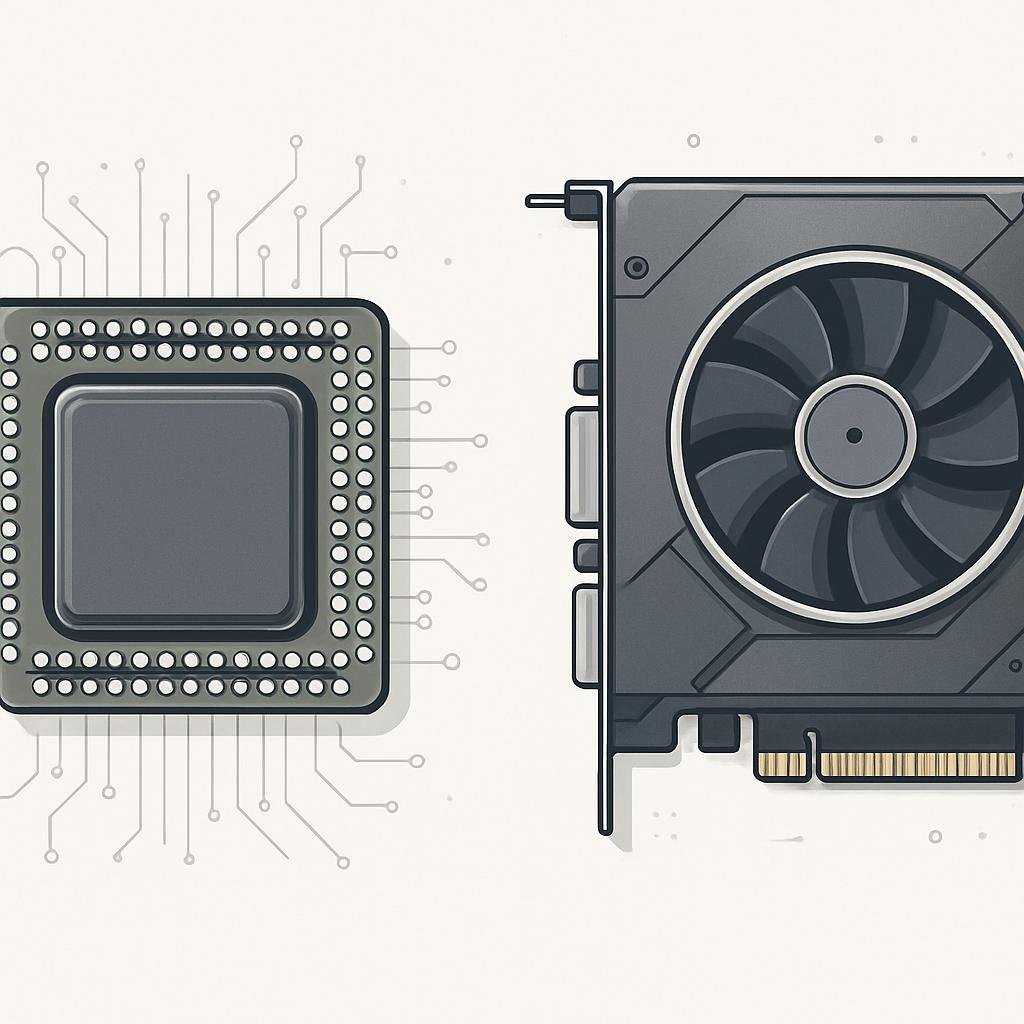
Choosing between a CPU and a GPU for your machine learning tasks can feel like picking the right tool from a massive toolbox. Each has its strengths and weaknesses, and knowing which one to use can dramatically impact your project’s efficiency and success.
What Is the Difference Between a CPU and a GPU?
At the most basic level, both CPUs (Central Processing Units) and GPUs (Graphics Processing Units) are processors that perform computations. However, they are designed for different types of tasks.
The CPU is the brain of the computer, designed to handle a wide range of tasks. It excels at sequential processing and is optimized for tasks that require high performance on a single core. This makes it suitable for tasks that need a lot of decision-making and complex calculations.
In contrast, the GPU is designed for massive parallel processing. Originally created to accelerate graphics rendering, GPUs have hundreds or thousands of smaller cores that can perform many operations simultaneously. This parallelism makes GPUs particularly well-suited for tasks that can be broken down into smaller, independent operations, like matrix multiplications used in machine learning.
How CPUs and GPUs Work in Machine Learning
Understanding how CPUs and GPUs operate in the context of machine learning can help you decide which is more appropriate for your needs. Let’s dive into their specific roles and capabilities.
CPU Capabilities
CPUs are versatile and handle a broad range of operations. They are ideal for:
- Data Preprocessing: CPUs can efficiently handle data preparation tasks such as cleaning and organizing datasets before they are fed into a machine learning model.
- Complex Control-Flow Tasks: Tasks that require complex logic and decision-making are more suited to CPUs due to their powerful cores.
- Training Small Models: When working with smaller datasets or less complex models, the speed advantage of a GPU may not be necessary.
GPU Capabilities
GPUs, with their parallel processing power, are particularly beneficial for certain machine learning tasks:
- Training Large Models: The parallel nature of GPUs makes them ideal for training large neural networks, where the same operations need to be performed on many data points simultaneously.
- Handling Big Data: When datasets are large and require extensive computation, GPUs can process these tasks more efficiently than CPUs.
- Accelerated Deep Learning: Deep learning frameworks like TensorFlow and PyTorch are optimized to take advantage of GPU architectures, significantly speeding up training times.
Step-by-Step Guide to Choosing Between CPU and GPU
Deciding whether to use a CPU or a GPU for your machine learning tasks depends on several factors. Follow these steps to make an informed choice:
1. Assess Your Task Requirements
Begin by evaluating the nature of your machine learning task:
- If your task involves a lot of data preprocessing, decision-making, and logic, a CPU will be more suitable.
- If you need to train a large neural network or handle extensive computations, consider using a GPU.
2. Evaluate the Size of Your Data
The size of your dataset plays a crucial role in your decision:
- For small to medium-sized datasets, a CPU may suffice.
- For large datasets requiring extensive computations, a GPU can offer significant speed improvements.
3. Consider Your Budget and Resources
CPUs are generally cheaper and more readily available than GPUs. However, if your work involves extensive deep learning training, investing in a GPU could be worthwhile.
4. Review Software Compatibility
Check the compatibility of your machine learning framework with GPUs. Most modern frameworks support GPU acceleration, but it’s always good to confirm.
Common Mistakes to Avoid
Even seasoned developers can make missteps when choosing between a CPU and a GPU. Here are some common mistakes and how to avoid them:
- Ignoring Task Requirements: Choosing hardware without considering the specific needs of your task can lead to inefficiency. Always align your choice with the task requirements.
- Overlooking Data Size: Using a GPU for small datasets may not provide noticeable benefits and can be an unnecessary expense.
- Neglecting Framework Support: Ensure your machine learning framework supports GPU acceleration to avoid compatibility issues.
- Underestimating Cost: GPUs can be expensive. Make sure the performance benefits justify the investment.
Real-World Examples
To better understand the practical applications of CPUs and GPUs in machine learning, let’s explore some real-world examples:
Using a CPU for Natural Language Processing (NLP)
Consider a project involving sentiment analysis on a medium-sized text dataset. CPUs are well-suited for this task due to their ability to handle sequential data processing efficiently. By leveraging a CPU, you can preprocess the text, apply tokenization, and perform sentiment analysis without the need for high parallel computation.
Leveraging a GPU for Image Classification
For a task like image classification using convolutional neural networks (CNNs), a GPU is ideal. The parallel processing capability of GPUs allows for rapid training of the CNN, processing multiple images simultaneously, and significantly reducing training time compared to CPUs.
Deep Learning with GPUs in Autonomous Vehicles
Autonomous vehicles rely heavily on deep learning models for object detection and decision-making. These models require processing vast amounts of data from sensors and cameras in real-time. GPUs are essential in this scenario, providing the necessary computational power to handle the workload efficiently.
Final Thoughts
Choosing between a CPU and a GPU for machine learning tasks boils down to understanding your specific requirements and the nature of the task at hand. CPUs offer versatility and are suitable for tasks that require complex logic, while GPUs provide the parallel processing power necessary for large-scale data and deep learning models. By carefully evaluating your needs, data size, budget, and software compatibility, you can make an informed decision that maximizes efficiency and performance in your machine learning projects.